

Submitting more applications increases your chances of landing a job.
Here’s how busy the average job seeker was last month:
Opportunities viewed
Applications submitted
Keep exploring and applying to maximize your chances!
Looking for employers with a proven track record of hiring women?
Click here to explore opportunities now!You are invited to participate in a survey designed to help researchers understand how best to match workers to the types of jobs they are searching for
Would You Be Likely to Participate?
If selected, we will contact you via email with further instructions and details about your participation.
You will receive a $7 payout for answering the survey.
You have a question.
You type it into the team chat.
Delete it.
Type it again.
Maybe you can figure it out yourself.
Ten minutes later, you're searching through old emails, opening documents you barely remember, and trying to piece together an answer to something your colleague could probably explain in 30 seconds.
All because you didn't want to ask.
If this sounds familiar, you're far from alone. Feeling nervous about asking questions at work can happen at any career level, but it can be especially common when you're new to a job, working with more experienced colleagues, or trying to prove yourself.
You don't want to look inexperienced. You don't want to interrupt someone. And you definitely don't want to ask something everyone else apparently already knows.
But learning how to ask questions at work confidently is an important professional skill. The right questions can help you understand expectations, avoid unnecessary mistakes, learn faster, and ultimately become more independent.
The goal isn't to ask about everything.
It's to become better at knowing what to ask, when to ask it, and how to ask well.
Usually, the question itself isn't the problem.
It's what you worry the question might communicate.
Will they think I should already know this?
Am I bothering them?
Was this explained before and I forgot?
What if everyone else understands except me?
Will I look less capable?
These thoughts can make a simple question feel much bigger than it actually is.
This is particularly common in a new job, where you're learning several things at once: the role, the team, internal processes, expectations, terminology, systems, and all the unwritten rules nobody thought to include in your onboarding.
You might be perfectly capable and still have dozens of questions.
Those two things aren't contradictory.
There's an important distinction between asking for guidance and immediately asking someone else to solve every problem for you.
Good independent workers ask questions too.
The difference is often in what happens before the question.
Imagine you're unsure how to prepare a particular report.
Compare:
"How do I do this?"
with:
"I've reviewed last month's report and the instructions in the shared folder. I understand sections A and B, but I'm not sure whether this month's regional figures should be included in section C. Could you clarify?"
Both are questions.
But the second one shows that you've already investigated the problem, narrowed down what you don't understand, and made it easier for the other person to help.
That's a professional question.
You don't need to ask a colleague every time you encounter something unfamiliar.
But you also shouldn't spend two hours searching for an answer someone could give you in two minutes.
A useful question to ask yourself is:
Can I reasonably find a reliable answer myself?
If the answer is documented clearly in a system, guide, previous email, or project brief, checking there first makes sense.
But if the question depends on someone's expectations, an internal decision, unclear instructions, missing context, or information you don't have access to, asking is often more efficient.
There is no prize for spending half your afternoon secretly confused.
Not all questions have the same consequences.
Suppose you're choosing between two fonts for an internal presentation. You can probably make a reasonable decision and continue.
Now suppose you're about to send pricing information to a client and you're unsure which figures have been approved.
That's different.
The greater the potential impact of getting something wrong, the stronger the case for clarifying before acting.
This applies particularly to decisions involving clients, money, deadlines, confidential information, legal or compliance requirements, public communications, and work that will affect other teams.
Being independent doesn't mean guessing when the consequences matter.
One of the biggest problems with avoiding questions isn't the initial uncertainty; it's what happens when you hide it for too long.
Imagine receiving an assignment on Monday that is due Thursday. You aren't completely sure what your manager expects, but you don't want to ask.
So you work on it Monday. And Tuesday. And Wednesday. Then on Thursday, you discover you've interpreted the assignment incorrectly.
Now both you and your manager have a much bigger problem than the question you could have asked on Monday. When instructions are genuinely unclear, clarifying expectations early can save enormous amounts of time.
"Can you explain the project?" is difficult to answer.
"Which customer segment are we prioritizing in this section?" is easy.
Before asking someone a question, try to identify exactly where your understanding stops.
Instead of:
"I don't understand what I'm supposed to do."
Try:
"I understand that I'm responsible for preparing the analysis, but I'm unclear whether you want it broken down by country or presented as one regional figure."
Specific questions are easier to answer and show that you've already thought about the task.
Sometimes a question makes perfect sense inside your head because you've been thinking about the problem for an hour.
The person receiving it hasn't.
So instead of messaging your manager:
"Should I include it?"
Give them the missing context:
"I'm finalizing tomorrow's client presentation. Should I include the preliminary July figures, or only the finalized June data?"
A few extra words can eliminate an entire round of messages.
This is particularly useful when you're asking questions over email or chat, where the other person can't see what you're looking at.
One of the easiest ways to become more confident asking questions at work is to stop thinking of every question as a request for an answer.
Sometimes you're asking for confirmation of your judgment.
For example:
"The supplier can't meet the original deadline. I think we have two realistic options: move delivery to Thursday or use the alternative supplier at a slightly higher cost. I'd recommend the second option because it protects the launch date. Does that approach make sense?"
You're still asking for guidance.
But you're also demonstrating problem-solving, judgment, and ownership.
As you become more experienced, questions like these often become increasingly important.
Sometimes the awkwardness isn't about what you're asking.
It's about when.
If your manager is walking into a meeting, that may not be the ideal moment to ask for a detailed explanation of next quarter's strategy.
If your colleague is clearly concentrating, five separate messages over 20 minutes may be more disruptive than one organized conversation.
When a question isn't urgent, consider collecting a few related questions and discussing them together.
You can also ask:
"Do you have five minutes today for a couple of questions about the project?"
That gives the other person some control over timing while still getting you the information you need.
It happens.
Maybe you forgot.
Maybe the answer didn't make sense the first time.
Maybe you wrote it down but can't find your notes.
Don't pretend you understand something when you don't.
Instead, acknowledge it:
"I know we discussed this before, but I want to make sure I've understood it correctly. When X happens, should I do Y or Z?"
Then write down the answer somewhere useful.
The real problem isn't asking twice.
It's repeatedly asking the same basic question without creating a way to remember the answer.
You don't have to become the person who asks five questions in every meeting.
Start smaller.
Ask one.
If speaking spontaneously in meetings makes you uncomfortable, prepare your question beforehand. Write down anything that isn't clear while other people are talking. Then choose the most useful question to raise.
You can also follow up after the meeting when appropriate.
Confidence at work doesn't always arrive before you do something.
Sometimes it develops because you've done the thing enough times to realize it wasn't as intimidating as you expected.
There's another reason learning to ask good questions matters.
Questions don't only help you complete today's assignment.
They help you understand how your organization works.
Why does the team prioritize this metric?
How does my work affect the next stage?
What does my manager look for when reviewing this?
Why did we choose this approach rather than the alternative?
What would make this work stronger?
Those questions build context.
And context is often what separates someone who can complete assigned tasks from someone who understands the bigger picture and can eventually make good decisions without being told exactly what to do.
Ironically, asking thoughtful questions now can help you need less guidance later.
When you're unsure how to phrase something, use three parts:
Context + what you've tried + what you need clarified.
For example:
"I'm preparing the weekly performance report. I've checked the dashboard and last week's version, but I can't find the updated conversion figures for Saudi Arabia. Are those available somewhere else, or should I use the latest figures currently in the dashboard?"
It's clear.
It's specific.
And the person answering immediately understands what you need.
Asking questions at work doesn't have to mean constantly looking for reassurance.
Done well, it's part of becoming better at your job.
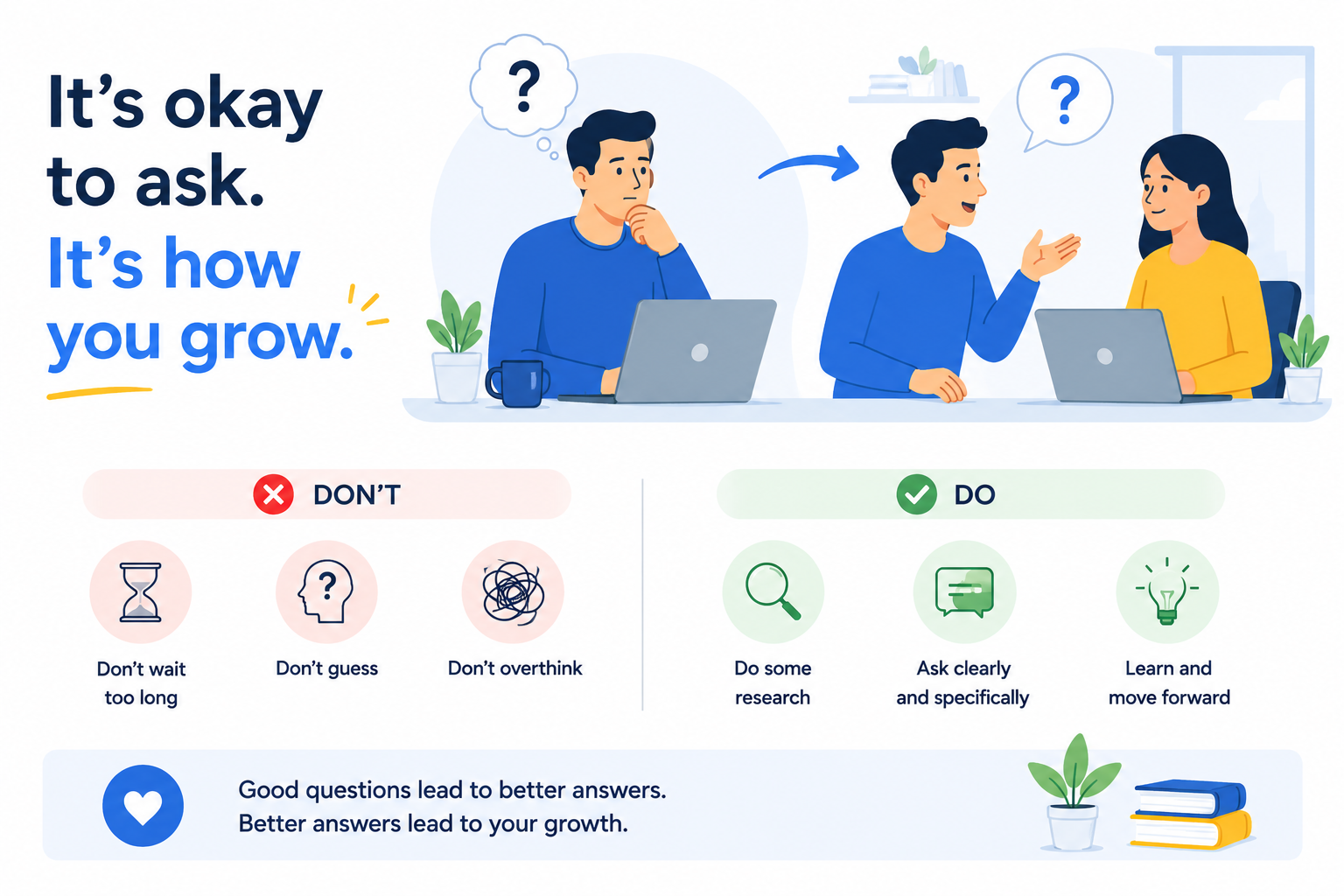
Do some thinking first.
Check the information already available to you.
Identify exactly what you don't understand.
Ask before uncertainty turns into an avoidable mistake.
And when you can, bring your own thinking to the conversation.
Over time, something interesting happens.
The questions change.
You stop asking, "What am I supposed to do?"
And start asking, "Here's what I think we should do. What am I missing?"
That's not a sign that you have fewer things to learn.
It's often a sign that you're getting better at learning them.
Explore more career advice on Bayt.com and find practical guidance to help you grow, communicate confidently, and succeed at work.